Monday, August 11, 2014

What is Fly Fishing?


There is nothing more commonly uttered by people who know nothing about fishing than: What is Fly Fishing? In most cases, these beginners think that fly-fishing is some strange special way of fishing where we sit down and try and catch flies with our rods rather than fish. But what most of these people don’t realize is that, fly-fishing is actually the most common form of fishing that we see represented in media and movies. This is because it is much easier to have someone cast a line with a fake fly as bait than it is with live bait of any kind.
 
And that’s just what fly-fishing really is, you are using fake bait, made of plastic or metal or anything than carries enough weight to be able to cast the line properly into the water. Some people might just call that fishing, but it’s a very unique style that not everyone does. Some people prefer the use of worms or live bait of some kind, and others don’t use rods for fishing at all.

So if all that is changing is the use of fake bait instead of live bait, how does fly-fishing defer from fishing with live bait? Well that all comes down to the weights of a rod, the line, and the bait. Generally fake bait on a lure will weigh less than if you are using live stuff, and that means you have to really learn how to cast your line properly with less weight.

And if you think that is easy, try throwing a piece of paper toward someone without making any folds in the paper and see how far it gets or if it goes where you want it to. That’s the kind of challenge you face with fly fishing, and why many people prefer it. It’s also why you usually see people who fly fish will cast their line multiple times, or continually recast their line.

Either way it is certainly a fun method of fishing and everyone should at least try the casting once. The only other thing you have to decide is what kind of fly you want on the end of your line, and that’s a whole other matter to handle.

For More Details, Visit Home at http://www.LeesFerryFlyFishing.com

Friday, June 27, 2014

Late June-Early July


Hello to all my fellow fishers out there. This has been an epic year so far the fish are day and sassy, and we are seeing great numbers. Scenery is second to none, we have been seeing desert bighorn sheep just about everyday this June, the weather is also good, starting to get a little hot, but 100 degrees means cicadas, and they have started to buzz! I have been haveing some sucess and the big big patterns, and when the water flows go up to the projected 10,000-18,000 for July we should be in the money! The higher water means the cicadas will start coming in contact with the water more often and should get the fish to key on the drys near the shorelines! 
I look forward to seeing you all for the big bug season. 
As always "tight lines and always remeber to keep your tip up"!
Mick Lovett

For More Details, Visit Home at http://www.LeesFerryFlyFishing.com

Wednesday, June 4, 2014

Late May-early June


Hello everyone,
Fishing this spring has been fantastic. I have to say something about the health of the fish it is great this year even the little guys are day and fight hard the whole way in. Spring is midge season and this year has been no exception, catching then on #16-#18 in zebra midge patterns. Up river I have been doing real well on scud patters this year #12 pink, or ginger.
June flows are perfect 6,500-13,000cfs, and this has created tons of food, worms are now on the menu, #14, rust, brown, and red all producing fish. June is shaping up to be a really good month, watch future blogs for more details as the month goes on.
As always I wish you all tight lines and always remeber to keep your tip up!
Mick Lovett
Marble Canyon Outfitters


For More Details, Visit Home at http://www.LeesFerryFlyFishing.com

Thursday, May 29, 2014

Rainbow Trout is One of the Top Five Game Fish in America


Fly Fishing is always a great way to spend your day and the experience itself is enough to put a smile on your face for a long time. But what do we catch? Our main game is the rainbow trout and the best way to bring one (or several) home is to know your animal.

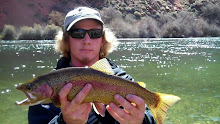
Adult freshwater rainbow trout range from 1 to 5 lbs., but lake trout can get as big as 20 lbs. Coloration of these fish range depending on species, but they live up to their title and exhibit gorgeous hues of reds, greens and blues here in Arizona. They also feature heavy black spotting.

Both wild and hatchery-bred rainbow trout can be found in over 45 countries and on every continent save Antarctica. They spawn in early to late spring (between January and June) when water temperatures reach 42 degrees Fahrenheit. The maximum-recorded lifespan is 11 years.

Though not particularly aggressive, rainbow trout are certainly predators that will eat anything they can get their jaws around. They generally feed on aquatic insects in larval, pupal and adult stages of life. These include caddisflies, stoneflies, mayflies and aquatic diptera. However, they’ll also chow down on fish eggs and even terrestrial insects that fall into the water like ants and beetles.

In fly-fishing circles, rainbow trout are known as one of the hardest-fighting fish. This is determined by their tendency to leap when hooked. They’re regarded as one of the top five game fish in America.

Rainbow fish are also highly regarded for their use in western cuisine. Seafood Watch named them a “best choice” fish for human consumption for their appealing flavor and high levels of vitamin B. Typical wine pairings for trout include chardonnay, sauvignon blancs and pinot gris.

When you’re ready to tackle a rainbow trout, contact Marble Canyon OutfittersWe can’t wait to get out on the Colorado River.

Equipment for Fly Fishing


Fly fishing can seem daunting, if only because of the amount of equipment involved. But how much of that is purely for show? We’ve put together a list of what you actually need to get started to make your first fly fishing experience a little less complicated.

Five-weight rods can handle any fish from 6 inches long to five pounds. For fish of this size, most fly reels, regardless of price, will work just fine. Weight-forward, five-weight floating lines work best for five-weight rods. Floating line is a simple place to start practicing your cast and works with wet and dry flies. Weight-forward just refers to the line’s taper.

Braided Dacron backing isn’t essential, but it will prevent any big fish from taking all of your line and make bringing your line back in a lot less painless. A standard nine-foot, 5X leader is the way to go with a five-weight line. These are tapered monofilament line. Keeping 5X tippets to replace portions of your 5X leader is always a good idea.

Neoprene waders will keep you warm in cool weather, but with the Summer season coming in, we suggest either going big with waterproof/breathable waders (a bit expensive, but often with a lifetime guarantee) or fabric waders. Fabric waders are prone to leaks, but are one of the better options to avoid an uncomfortable trip.

Other items to never forget on your trip are wading boots, clippers, fly floatant, a net, forceps, a leader straightener and a fly vest or chest pack. These last two items should be comfortable as well as functional, as you’ll be wearing them all day.

Contact Marble Canyon Outfitters to get started on a guided day of fly fishing. You’ll be glad you did!