For MoEnvironmental Assessment (EA) for proposed alternatives to Mechanical Removal (MR) of Rainbow Trout (RBT)
1. The non native fish (NNF) control process should be (adjusted, amended, revised, modified, broadened, expanded, reinterpreted) to consider the status, i.e. current population, condition, carrying capacity, and trends of the targeted native fish (NF) before implementing any considered NNF control action.
Existing agreements/opinions between BOR and USFWS among other agencies require mandatory NNF control. This requirement is incorporated in a conservation measure to reduce the numbers of NNF. The current determination to implements NNF control is based on the (numbers, population, relative abundance) of NNF without considering the status of the target NF. A decision process that ignores countervailing information is arguably faulty and flawed. This produces difficult to support positions that confound common sense and undermine reasonable support for actions, including mechanical removal or other options for NNF control.
This problem of making decisions in a knowledge vacuum is compounded by the present status of the hump back chub (HBC). For reasons that are either speculative or unknown the present HBC population has risen to a level where the Biological Modeling Summary mentioned in #2 below includes the statement that 75% of the science participants accepted that “It is not likely that the Lower Colorado River (LCR) can support a much larger population of humpback chub, even if all predators (are) removed because little excess food production is available.”
The (mechanism, means) must exist in some form to review within the existing agreements/opinions the current situation to accomplish an integration of the relevant conditions of both NNF and NF before implementing any action for NNF control. The initiation and completion of this process should precede any components of the steps that are being presently being considered in the EA. The failure to address this present inconsistency erects a barrier making support from Tribal and other stakeholder interests for NNF control actions difficult to obtain.
2. The implementation of any proposed NNF control actions above Lee's Ferry should be deferred until the completion of the Grand Canyon Monitoring & Research Center (GCMRC) study "Detection of Rainbow Trout Movement from the Upper Reaches of the Colorado River below Glen Canyon Dam". The proposed GCMRC budget for FY2011 contains $437,000 and for FY 2012 contains $459,000 for these studies.
The "2010 Biological Modeling Summary by USGS/GCMRC, dated June 24, 2010 (BMS) presented a number of summary statements to which a "…subjective proportional level of certainty was assigned…to provide some relative quantification of the level of certainty knowledgeable scientists can assign to the conclusions". Among the scientists participating there was acceptance that most of the RBT were spawned at Lee's Ferry. However, at present this is and will remain only conjecture until the actual science is done as proposed. The expenditure of nearly one million dollars and potentially more beyond 2012 is an indicator and a validation of the existence of sufficient uncertainty over NNF fish movement below Lee's Ferry before initiating control actions in the absence of a catastrophic event affecting NF.
3. Without the completion of A & B the implementation of any NNF control actions attempting to depress or control NNF reproduction by altering dam flows or redd related actions should be deferred. A & B are integral to making an informed science/management decision for the reasons stated above.
The BMS referred to in #2 includes a number of summary statements related to the effectiveness or outcome of dam flow and/or redd actions. The level of certainty of effectiveness was 50% for reducing predation pressure on humpback chub by removal of downstream migrants, 30% by altering ramping rates to disadvantage rainbow trout eggs, and 50% by altering ramping rates to reduce juvenile recruitment to the adult population.
In addition there was universal agreement of 100% that "When numbers of rainbow trout eggs or larvae are reduced at Lee's Ferry then survivorship of the remaining individuals increases, i.e. compensatory response.” This results in a conclusion that there is a 50% or less likely hood that any of the above actions will be effective and regardless of the actions the RBT numbers will increase to compensate for any decrease resulting from the actions. An unfortunate consequence from these actions could be Tribal reliance and agreement on a set of actions only to be confronted by their failure which would then be used as a rational to justify the resumption of MR.
4. The utilization of some combination of a rearing pond/hatchery operation for supplemental introductions of NF HBC should be a component of any NNF control plan and any NF conservation measure. Up to the present there have been a number of actions, studies, activities projects, etc. in support of HBC. However, few if any of them have directly produced with certainty any HBC. They have functioned on the hope that by taking a peripheral action or creating a certain condition that perhaps the status, population, and distribution of HBC would improve.
There are several rearing pond options available or being proposed that will produce transplantable or translocatable HBC. These ponds can be stocked with a combination of fingerlings from either Dexter and/or the LCR. The use from a combination of these sources removes any genetic issues. The rearing ponds will provide HBC of a sufficient size to reduce predation and can be used to enhance or expand existing HBC locations. Grand Canyon National Park Service is developing a plan for the Colorado River mainstream and tributaries that requires a source of HBC for installing in a number of locations. By only installing the HBC outside of the LCR, except in the event of a severe decline or catastrophic event, GCMRC studies in the LCR can continue and any potential conflicts with the Environmental Species Act or other regulations can be avoided.
There is budget money available to implement a rearing pond project. The proposed FY 2011 GCMRC budget redirects $600,000 from the NNF Suppression Contingency Fund to the Experimental Fund. Considering the apparent current status of the HBC and in light of #1, #2, and #3 above those funds would not be required in FY2011 and should be available to initiate rearing ponds. re Details, Visit Home at http://www.LeesFerryFlyFishing.com

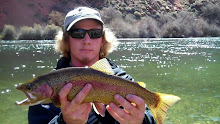
 Chris Rich, With another nice rainbow caught Nov. 1st. The fish seem to be settling in to the high winter flows. They have been taking natural colored worms, Crystal flash midges, zebra midges, egg patterns and some scuds in live colors.